
There’s a specific silence that fills a room when someone unwraps a painting on the other side of a move and finds a tear across the canvas. Or the sound of a chandelier crystal hitting a tile floor. If you’ve moved a villa before, you know the feeling. If you haven’t, this is the part of the move nobody warns you about.
At E Home Movers, we’ve handled thousands of villa relocations, and the same three items cause the most stress every time: artwork, chandeliers, and large mirrors. They’re heavy, awkward, expensive to replace, and often impossible to replace at all. Get them wrong, and one broken item can cost more than the entire move. Get them right, and moving day feels boring in the best way.
This guide walks through exactly how we pack each of these items, what materials you actually need, and the mistakes we see homeowners make when they try it themselves.
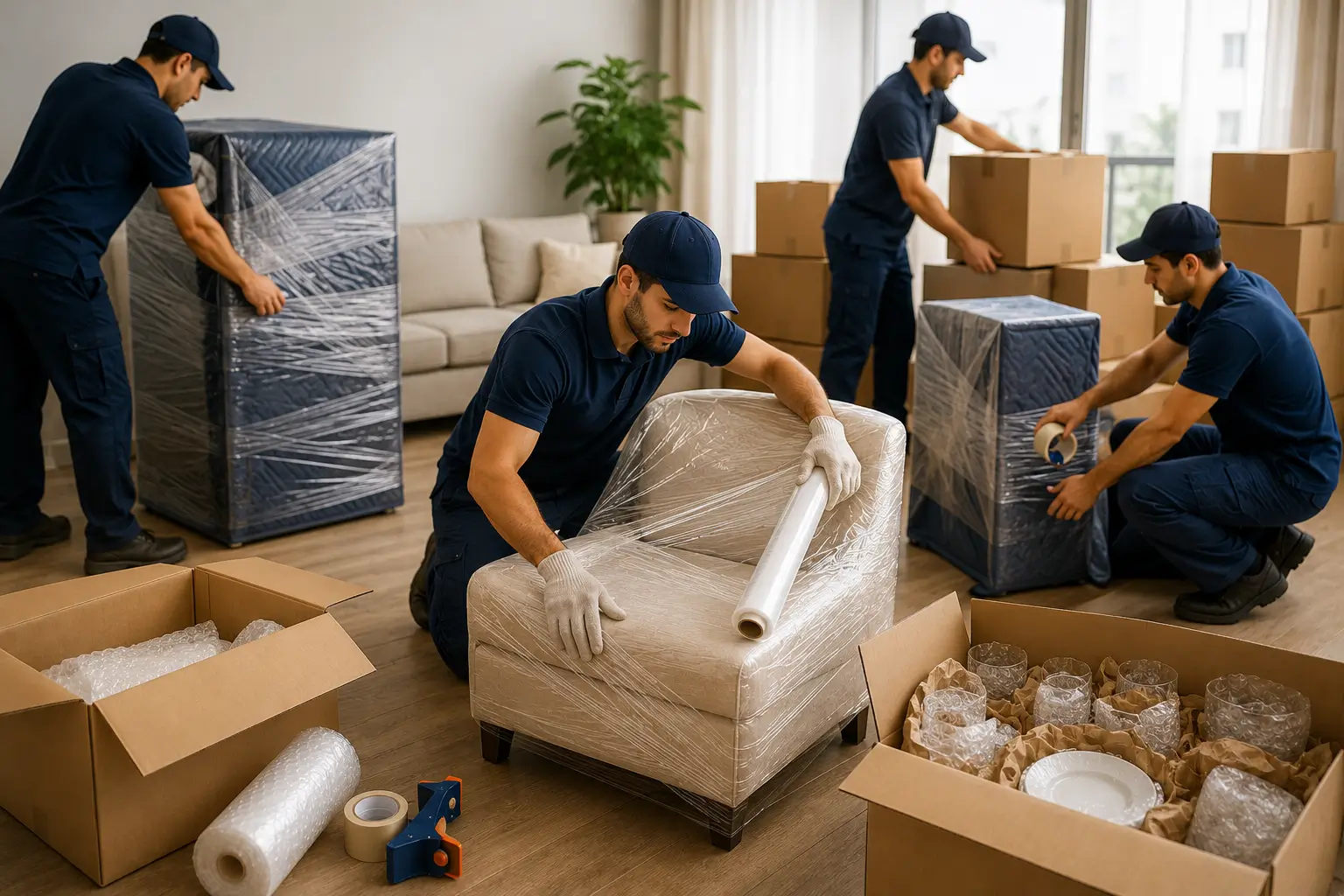
Why fragile items need their own moving plan
Most damage during a villa move doesn’t happen in the truck. It happens in the ten minutes before an item goes into the truck, and the ten minutes after it comes out. That’s when items get set down on hard floors, leaned against sharp corners, or stacked under something heavier than expected.
Artwork, chandeliers, and mirrors share three problems that regular furniture doesn’t have:
- They’re rigid but brittle. A sofa can absorb a bump. A framed oil painting can’t.
- They’re oddly shaped. Nothing stacks cleanly against a chandelier or a six-foot mirror.
- Their damage is often invisible until it’s too late. A hairline crack in a mirror or a bent chandelier arm may not show up until the item is hung in the new villa.
The fix is to treat each of these items as its own mini-project with its own materials, its own packing time, and its own place in the truck. Don’t mix them into the general packing flow.
Packing large artwork
Framed paintings, canvases, and oversized prints all need slightly different treatment, but the core method is the same.
What you’ll need
- Glassine paper or acid-free tissue (protects the surface)
- Painter’s tape (not masking tape, and never on the artwork itself)
- Corrugated cardboard corner protectors
- Bubble wrap, bubble side inward
- Foam board or extra flat cardboard
- Custom-cut art boxes, or telescoping picture boxes
- A permanent marker for labeling
Step-by-step
- Cover the face first. Lay a sheet of glassine paper or acid-free tissue across the front of the artwork. This stops the surface from sticking to plastic wrap in warm weather, which is a real risk in villa climates.
- Tape a large X across any glass. Painter’s tape across the glass (not the frame) keeps a broken pane from shattering inward onto the artwork if the worst happens. Do not skip this if the frame has glass.
- Add corner protectors. Slide cardboard corner protectors onto all four corners of the frame.
- Wrap in bubble wrap, bubble side in. Two full layers. The bubbles face the artwork so they cushion it; the smooth side faces out so tape doesn’t tear bubbles when you unwrap it later.
- Sandwich between foam boards. For anything larger than about 60 cm on the long side, add a flat sheet of foam board or extra cardboard on the front and back. This is what stops flexing during transport.
- Box it. Use a picture box that’s about 5 cm larger than the wrapped artwork on all sides. Fill the gap with packing paper so the piece can’t shift.
- Label it clearly. Write “FRAGILE — ARTWORK — THIS SIDE UP” on both flat sides and both edges. Include the destination room.
Canvases without frames
Unframed canvases are more forgiving in some ways and more delicate in others. Never wrap a bare canvas tightly in plastic; humidity gets trapped and the canvas can warp. Use glassine first, then a breathable material like a moving blanket, then place inside a rigid box that’s slightly oversized.
Oversized pieces
If a piece is larger than 120 cm on the long side, get a custom crate built. This sounds excessive until you compare the cost of a wooden crate with the cost of replacing a damaged original.
How to safely dismantle and pack a chandelier
Chandeliers are the item most homeowners underestimate. They look delicate, so people handle them gently, but the failure point is almost never the crystals. It’s the wiring at the ceiling, the arms of the frame, and the small screws holding the whole thing together.
Before you touch it
- Turn the power off at the breaker. Not just the switch. The breaker.
- Photograph the chandelier from every angle, including close-ups of how each crystal or arm attaches. This is your reassembly guide.
- Have two people ready. One holds, one unscrews. Solo chandelier removal is how ceilings get damaged.
Step-by-step
- Tape an X across the mirror surface. This is non-negotiable for any mirror larger than about 40 cm.
- Cover the face with paper. Glassine or brown paper, taped to the frame (never to the mirror itself).
- Add corner protectors. Slide them onto all four corners.
- Sandwich between two flat sheets of cardboard. Cut them to the exact size of the mirror. Tape them together around the edges so the mirror is held in a rigid cardboard case.
- Wrap the whole sandwich in bubble wrap. Two layers.
- Slide into a mirror box. Fill any gaps with packing paper so nothing shifts.
- Label as “FRAGILE — MIRROR — DO NOT LAY FLAT.”
How far in advance should I start packing fragile items? Start at least two weeks before moving day. Chandeliers alone can take a full day to dismantle and pack properly if you have more than one in the villa.
Can E Home Movers pack these items for me? Yes. Our specialty packing service covers artwork, chandeliers, mirrors, antiques, and other high-value items. We bring the materials, do the packing, load, transport, and unpack at the new villa.
Do I need insurance for high-value artwork? If a piece is worth more than the standard coverage in your moving contract, ask for a valuation upgrade before the move. Standard cover rarely matches the replacement cost of original artwork.
What about very large wall mirrors that are glued to the wall? These usually can’t be removed without breaking them. We can assess on a pre-move survey and advise whether removal is realistic, or whether the mirror stays with the property.
Can I pack the chandelier crystals loose in a bag? No. Crystals scratch each other, and the coatings chip. Each one needs to be wrapped individually or placed in a compartmented box.
Ready to move without the stress?
A villa move should not end with a broken chandelier on the marble floor or a torn canvas leaning against the wall. Whether you pack these items yourself using this guide, or you’d rather leave the fragile work to a team that does it every day, the goal is the same: everything arrives at the new villa exactly the way it left the old one.
E Home Movers offers full-service villa relocations with specialty packing for artwork, chandeliers, and mirrors. Request a free quote and we’ll book a pre-move survey, itemize your fragile pieces, and give you a fixed price with no moving-day surprises.